Water heaters, priced on the size of the tank.
No hot water, rusty hot water, a puddle under the tank or a noise like gravel in a clothes dryer. Work out your own price range on this page before you speak to anybody, including us.
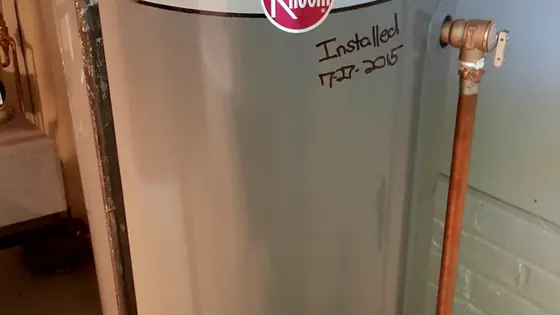
WHY YOURS DIED EARLY
Valley water is hard on a tank.
Water in this part of the Central Valley carries a lot of dissolved mineral. Every time your heater runs, some of it drops out of solution and settles on the bottom of the tank as scale. On a gas heater that is exactly where the burner is.
The scale acts like a blanket. The burner has to run longer to push heat through it, the steel above the burner runs hotter than it was designed to, and the glass lining that protects that steel starts to fail. That is the rumbling and popping you hear. It is water flashing to steam underneath the sediment.
A tank rated for twelve years often gives eight out here. The sacrificial anode rod, which is a length of magnesium hanging inside the tank whose entire job is to corrode instead of the steel, gets used up faster too. Nobody ever checks it, and it costs a fraction of a new heater.
The cheapest thing you will ever do for a water heater is flush it once a year and have the anode rod looked at every three or four. It is inside the one hour minimum, and it routinely buys people an extra four or five years.
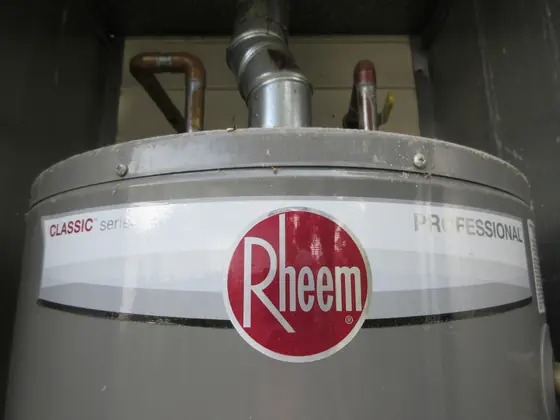
WHEN TO WORRY
Six signs, in the order they usually appear.
Water heaters rarely fail without warning. They fail after months of quiet warning that nobody was looking for. If you recognize more than two of these, get it looked at before it picks its own moment.
Rumbling, popping or a kettle sound
Sediment on the tank floor with water boiling underneath it. Not dangerous on its own, but it means the tank is running hotter than it should and the clock is going faster.
Hot water runs out sooner than it did
Sediment is taking up volume that used to be water, and the burner is working through a layer of insulation to reach it. A fifty gallon tank can behave like a forty.
Rusty or metallic tasting hot water
Cold water fine, hot water discolored. That is usually the anode rod fully consumed and the tank lining starting to go. Once you see this, replacement is close.
Weeping from the temperature and pressure valve
Sometimes it is a failed valve, which is cheap. Sometimes it is genuine over pressure in the system, which needs an expansion tank. Never plug it and never cap it.
Damp or staining around the base
If it is coming from a fitting, that is a repair. If it is coming from the tank body itself, there is no repair. A tank that is seeping is a tank that will eventually open up.
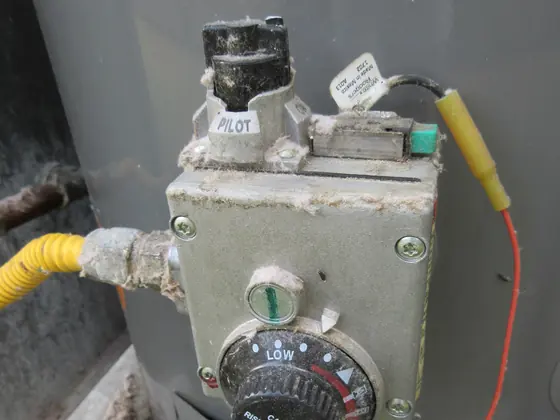
The pilot will not stay lit
Usually a thermocouple or a flame sensor, which is an affordable fix on a heater with years left. On a fifteen year old tank it is worth asking whether it is worth doing.
WORK OUT YOUR OWN NUMBER
The estimator.
Ron told Cassie that water heater pricing depends on the size of the unit, so rather than make you ring up to find out, here it is. This gives you a range, not a quote. The final figure gets confirmed on site once Ron has seen the space, the venting and the connections.
Seismic strapping and the permit are in every figure above because in California they are not optional, and quoting without them is how a low number turns into a higher bill.
TANK, TANKLESS OR HEAT PUMP
Which one is actually right for your house.
Tankless gets sold hard, and it is genuinely excellent in the right house. It is a poor deal in the wrong one. Here is the honest version.
| Storage tank | Tankless gas | Heat pump hybrid | |
|---|---|---|---|
| Up front | Lowest | Highest | High |
| Running cost | Moderate | Lower than a tank | Lowest by a distance |
| Hot water | Runs out, then reheats | Does not run out | Runs out, reheats slowly |
| Install work | Usually a straight swap | Gas resize and new venting almost always | Needs space, air volume and a condensate drain |
| Life expectancy | 8 to 12 years here | 15 to 20 with descaling | 10 to 15 |
| Hard water | Scales the tank floor | Scales the heat exchanger, needs an annual flush | Same as a tank |
| Best for | Most valley homes, replacing like for like | Big families, long showers, a house that can take the gas upgrade | A garage install where electricity costs are the concern |
The honest tankless caveat
A tankless unit wants more gas than a tank does. In a lot of the older Tracy and Manteca housing the existing gas line will not carry it, so the real cost of going tankless includes a resize back toward the meter. If somebody quotes you tankless without mentioning the gas line, ask them about it.
And the hard water caveat
Tankless heat exchangers scale up just like tanks do, only the passages are much narrower so it matters sooner. In this water they want flushing annually. If nobody is going to do that, a tank is the more sensible purchase.
WHAT THE FOUR HOURS ARE
Where the time actually goes.
Cassie mentioned that a water heater job runs about four hours. People sometimes assume that is padding, so here is the breakdown of a normal, uncomplicated swap.
- Shut down, drain the old tank and disconnect gas, water and vent. A full fifty gallon tank takes a while to empty and it empties at the speed the hose bibb allows.
- Get the old one out. In a garage that is easy. Up a set of attic stairs or out of a hallway closet it is not.
- Set the new tank, level it, and make up the water connections.
- Gas connection, then a leak test on every joint. This part does not get rushed.
- Vent connection and draft check, so combustion products go up the flue and not into the house.
- Seismic strapping at the upper and lower third, which is California code.
- Fill, purge the air out of the hot side, light it, set the temperature and watch it through a full first heat cycle.
- Haul the old unit away and clean up.
Four hours is a fair, honest number for that list. Some come in at three. An attic install with dated venting can go past five, and if it is heading that way you will hear about it while it is happening rather than at the end.
SIZING IT
Bigger is not automatically better.
An oversized tank keeps more water hot than you will ever use, and you pay to keep it hot every hour of every day. An undersized one leaves the last person in the shower doing the thing everybody does where they stand slightly to one side.
| Household | Bathrooms | Gas tank | Electric tank |
|---|---|---|---|
| 1 to 2 people | 1 | 30 to 40 gal | 40 gal |
| 2 to 3 people | 1 to 2 | 40 gal | 50 gal |
| 3 to 4 people | 2 | 40 to 50 gal | 50 to 66 gal |
| 5 or more | 2 to 3 | 50 to 75 gal | 80 gal |
If everybody in your house showers inside the same ninety minutes, size up one step from this table. If your showers are spread across the morning, do not.
Water heater questions
No hot water this morning?
Ring (209) 278-4781 and Cassie will find you the first slot Ron has. If it can wait, book it online and pick your own time.